Evga Geforce Rtx 2080 Ti Xc Ultra Review
Review: EVGA GeForce RTX 2080 XC Ultra Gaming
Introduction
The GeForce RTX 2080 Ti and RTX 2080 rolled into review town on Wednesday. Based on the all-new Turing blueprint and housing an eclectic mix of compute cores for traditional rasterisation, ray tracing and deep learning, these cards characteristic the nigh forward-looking architecture ever. Our results showed that while RTX 2080 was marginally faster than the last-gen GTX 1080 Ti in today's games, information technology had the power to streak up to 50 per cent alee when using its smart muscle to the fullest.
And Nvidia fabricated the assuming move of releasing its all-time-e'er Founders Edition (Atomic number 26) cards overclocked out of the box. The RTX 2080 model ships with a core boost speed of 1,800MHz, offering upward 90MHz more than speed than stock. Meanwhile, the well-constructed FE design is available for £749, which is cheaper than practically all aftermarket cards.
And so not only do add-in board cards need to outperform the Fe model, they too need to look great and be in the aforementioned fiscal ball park. Puts all these partners in a sticky situation, doesn't information technology?
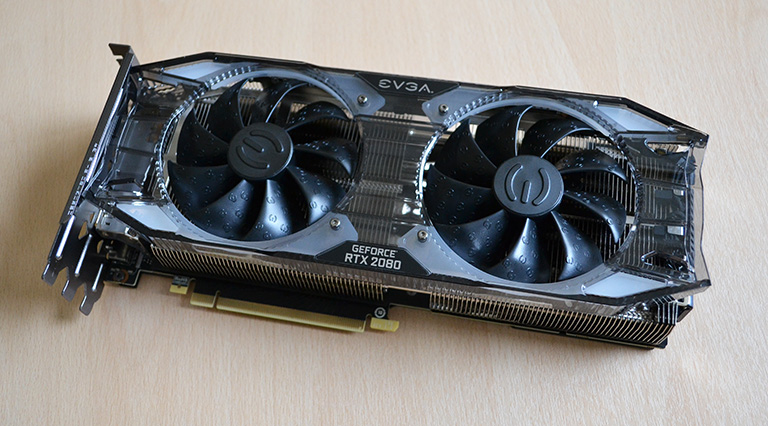
Such positioning headaches aren't bothering Nvidia stalwart EVGA. It has four GeForce RTX 2080 cards in its arsenal. Understanding the positioning requires some additional examination. The $750 XC Black Gaming uses the reference PCB but an all-new cooler on height, which nosotros volition talk about in a bit. Using a dual-slot form gene and measuring 269mm long, its heave clock is a relatively anaemic 1,740MHz. Spending an extra $50 brings the same-sized, same-cooled XC Gaming into view. The simply meaningful divergence is the engine clock is boosted to i,800MHz, matching the Nvidia Founders Edition for speed and U.s. toll.
The third choice and carte in for review today is the XC Ultra Gaming. Though the same width and height as the aforementioned duo, EVGA increases the heatsink majority and extends the grade factor to 2.75 slots. Heavy-duty cooling enables the card to up its core speed marginally, to a boost 1,815MHz, though you will have to pay the equivalent of $850 for the privilege.
Last merely not least, pushing the boat out is the $900 FTW3 Ultra Gaming. Using a custom PCB that's bigger - 302mm long, 139mm loftier and the same 2.75 slots equally the XC Ultra - EVGA is withal to finalise the core clock. We'd wait to see 1,850MHz at a minimum. It is the simply card to feature dual BIOSes, too. Having differentiated on libation and core speed, every EVGA RTX 2080 keeps memory speed at a standard 1,400MHz.
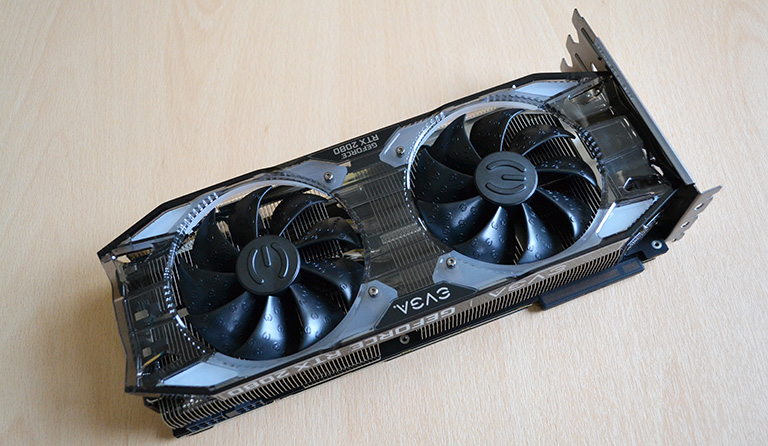
Coming back to the review menu, the rather big XC Ultra, it's clear that EVGA is going with the bigger-is-amend arroyo. Detect the milky-coloured plastic sections surrounding the fans? That'south standard livery for the carte du jour, though you are able to customise to either red or black trim kits by registering your menu with EVGA and getting them for free while stocks last - there are 2,000 of these kits available for the RTX 2080 Ti and RTX 2080.
Having a ii.75-slot form factor enables EVGA to use a taller heatsink-and-fan associates than on the dual-slot models. The cooling is very substantial, most likely overkill for what is a 210W TDP card, and leaves the Ninety Ultra looking overtly brutish compared to the Founders Edition card.
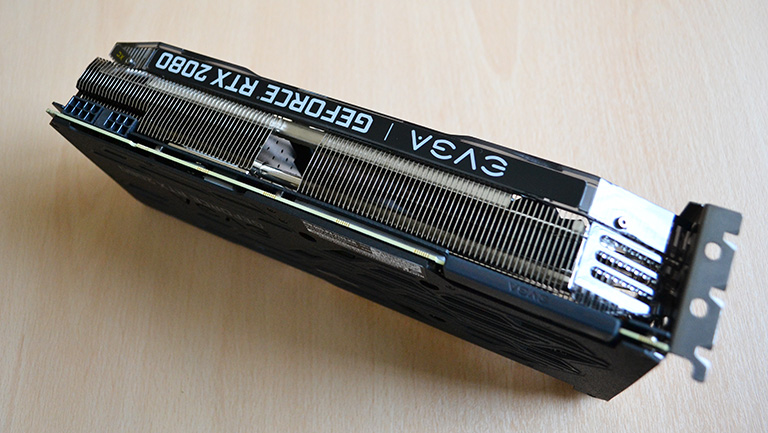
The aluminium fins run about 80 per cent along the way of the PCB. The two heatsink sections are connected via six heatpipes - the fundamental quartet are flattened - and the whole assembly sits on top of a near-PCB-broad plate that is in direct contact with the VRMs and memory fries underneath. It is of no surprise that this libation is too used on the hotter-running Ti model.
Information technology'southward the first time EVGA uses hydro-dynamic begetting fans for, it claims, lower racket at load. Every bit expected and dissimilar the FE card, the fans switch off at moderate load - the GPU needs to hit around 55°C earlier they bother spinning upwardly, going by our tests. Overall build quality is robust, and it needs to be on a card weighing 1,261g, which is virtually the same equally the Atomic number 26.
Above is a better view of those numerous tall aluminium fins. The entire card's name is backlit with RGB LEDs controllable by a subsection in the EVGA Precision X1 software. You can alter the colour, obviously, but also control the LED brightness and, if using the breathing mode, define the speed of change.
It's a shame that not more of the carte gets the RGB handling, if y'all are into that kind of thing, considering this sliver of lighting looks somewhat out of identify on a GPU of this heft. Should you wish, the lighting tin can be turned off altogether, as well.
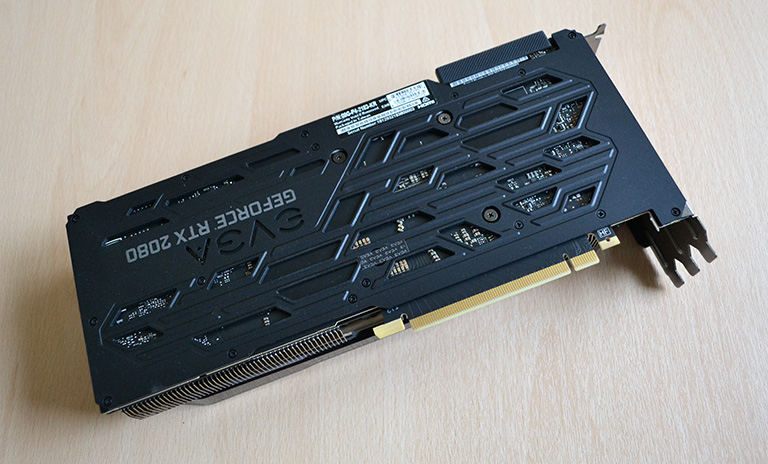
As the underlying PCB is reference insofar as it is largely a re-create of the Atomic number 26's, the XC Ultra uses standard 8+six-pin ability delivery, and then everything applicable to that menu - ability phases, TDP, etc. - is as well valid here. What this really means is that EVGA will have a tough time differentiating its performance from the Nvidia's model.
Keeping such a large menu rigid enough requires a custom frame on the back that feels plasticky compared to the thick metal present on Nvidia'south reference bill of fare. Sensibly, there are thermal pads between information technology and some of the components on the rear. Nvidia's rather chunky NVLink is in articulate evidence top-correct, as well.
Though such observations are personal, the Founders Edition feels like more of a premium production cheers to its all-round aluminium coverage and attractive industrial pattern. It's horses for courses, we gauge, and a couple of potential downsides of the Fe are a lack of RGB bling, if that's your thing, and always-on fans.
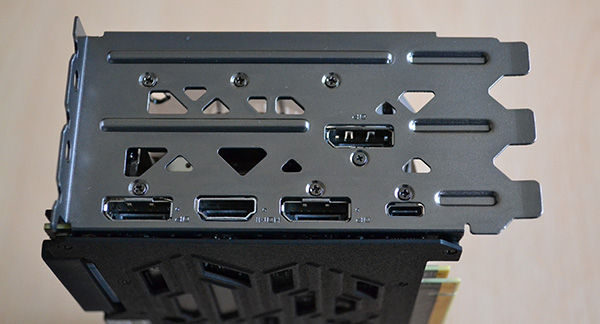
Going large on superlative requires a three-slot I/O section that looks ungainly. What you'll notice is that the five outputs are all in the same position as the original card, which makes sense, so the upper segment is largely wasted. As usual, the card is backed by EVGA'south three-year warranty.
Over the swimming the premium for this card is $50 over the Nvidia Founders Edition. Over here in the UK the price divergence is at least £100 - £850 vs. £750 - so the question is how does EVGA justify it. Let'due south have a expect at the benchmarks before making upward our mind.
Source: https://hexus.net/tech/reviews/graphics/122366-evga-geforce-rtx-2080-xc-ultra-gaming/
0 Response to "Evga Geforce Rtx 2080 Ti Xc Ultra Review"
Post a Comment