Main Them Rose Window Is Reinforcing Here With Multiple References to Royalty Ap Art History
Gothic cathedrals are some of the near recognizable and magnificent architectural feats. With soaring towers and softly filtered light streaming through stained glass windows, everything about the Gothic cathedral is transportive and ethereal, lifting the gaze of the viewer towards the heavens. Architectural innovations, such as flying buttresses, were essential to creating the Gothic style, but information technology was the new, intentional use of light that truly ready Gothic architecture apart from its heavier and darker Romanesque predecessors.
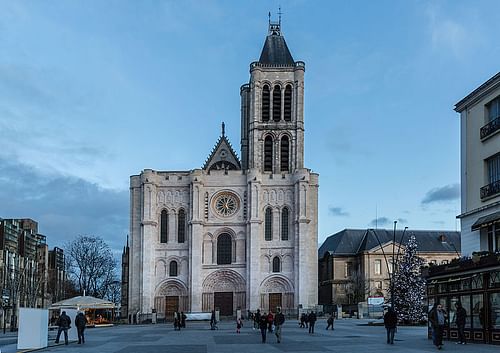
Basilica of Saint-Denis
The Gothic mode originated in 12th-century CE France in a suburb north of Paris, conceived of past Abbot Suger (1081-1151 CE), a powerful figure in French history and the mastermind behind the commencement-ever Gothic cathedral, the Basilica of Saint-Denis. For Suger, and other like-minded medieval theologians, light itself was divine and could be used to elevate human consciousness from an earthly realm to a heavenly one. Suger, and those who came after him, attempted to alluvion their cathedrals and abbeys with light, building taller and more elegant structures. This necessitated the adoption of some of the most obvious aspects of the Gothic form; pointed arches, rib vaults, and flight buttresses could be used to brand the walls taller and thinner past distributing the weight of the building more than finer.
Gothic churches could achieve new heights with a lightness & a gracefulness often absent from sturdy Romanesque structures.
Not anybody was a fan of the Gothic style. Giorgio Vasari (1511-1574 CE), the Italian artist and author whose works are considered to course the basis of modern art historical study, retrospectively named the fashion pioneered past Suger every bit "Gothic," which was meant to be derogatory. Writing in the late 16th century CE afterward the Gothic style had fallen out of favor, Vasari saw the style as degraded when compared to the classical forms of the Renaissance architecture of his own era. By calling it Gothic, he attempted to liken the manner to the "barbaric" Goths that had invaded Rome over a thousand years earlier. Still, Vasari'due south disapproval did not stop the Gothic revival from taking root in the late 18th century CE, and today millions of people each twelvemonth proceed to be captivated by the unearthly majesty of Gothic cathedrals.
Architectural Components
Preceded by the Romanesque style and followed past Renaissance compages, the Gothic style was pop throughout Europe from the 12th century through the 16th century. Gothic architecture did away with the thick, heavy walls, and rounded arches associated with Romanesque architecture by using flying buttresses and ribbed vaulting to relieve the thrust of the building outward, assuasive thinner and taller walls to be constructed. Gothic churches could achieve new heights with a lightness and a gracefulness often absent from sturdy Romanesque structures. Some of the key architectural components integral to the Gothic form are pointed arches, flight buttresses, tri-portal west façades, rib vaults, and of course, rose windows.
Pointed Arches
As opposed to the rounded arches commonly constitute in Romanesque buildings, Gothic structures are famous for their pointed arches that proved more adept at bearing weight. These pointed arches were not only used for applied reasons; they were symbolically pregnant in that they pointed towards heaven. The pointed arch, though not exclusively institute in Gothic architecture, became ane of the defining characteristics of the fashion.
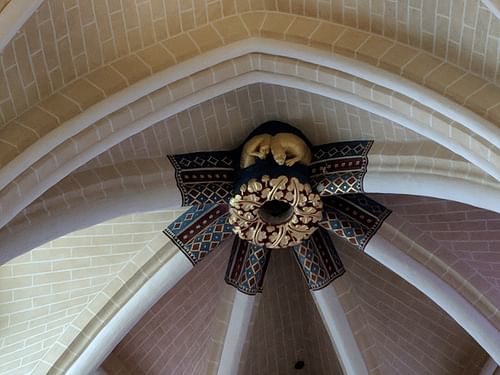
Arched Ceiling Detail at Chartres Cathedral
Flying Buttresses
Whereas Romanesque buildings had used internal buttresses equally a means of supporting weight, the buttresses of Gothic cathedrals are external. These and then-called flight buttresses allowed for churches to be built much taller, as the weight of the roof was dispersed away from the walls to an external load-bearing skeleton. Pushing back against the outward thrust of the walls, flying buttresses allowed for the soaring heights and alpine central naves of the Gothic cathedral.
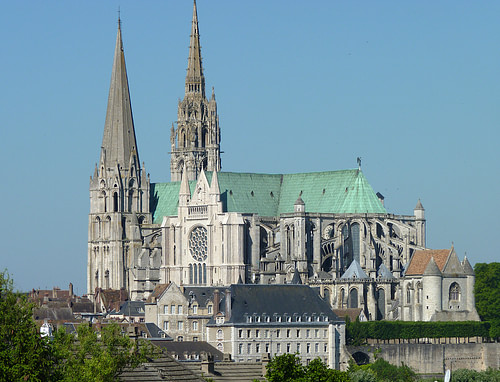
Chartres Cathedral
Tri-Portal W Façades
Another unique feature of the Gothic cathedral is the west façade, frequently seen as the front of the church building, which typically consists of ii towers, a central rose window, and three entranceways. The w façade of the Notre-Matriarch in Paris, for instance, is where the crowds besiege to gaze upward at the elaborate carvings that adorn the building. Elaborate sculptures carved into the tympanum in a higher place each doorway tell a story that a largely illiterate medieval population could understand. The central portal at Notre-Matriarch is known as the Portal of the Final Judgement, the left portal as the Portal of the Virgin, and the right every bit the Portal of Saint Anne.
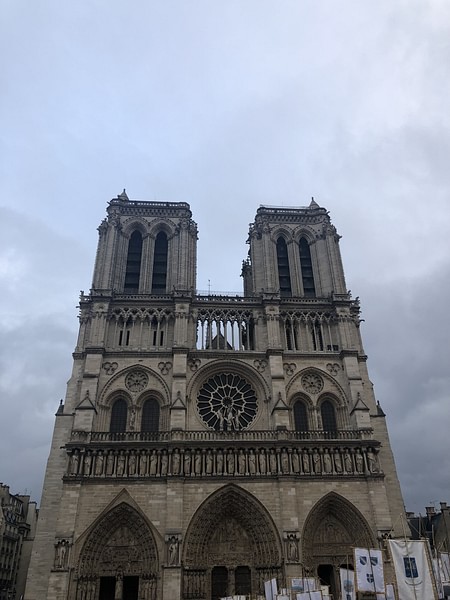
Notre-Dame Cathedral (Paris), Due west Façade
Rib Vaults
Ribbed vaulting is an essential technique that allowed for the overall increase in size and intricacy of design in Gothic structures. Romanesque structures had generally used barrel vaults and groin vaults. Gothic structures, on the other hand, used a diagonal framework known as rib vaults, enabling the edifice of taller and thinner structures. In a Gothic cathedral, it is like shooting fish in a barrel to spot the rib vaults crisscrossing the ceiling of the central nave.
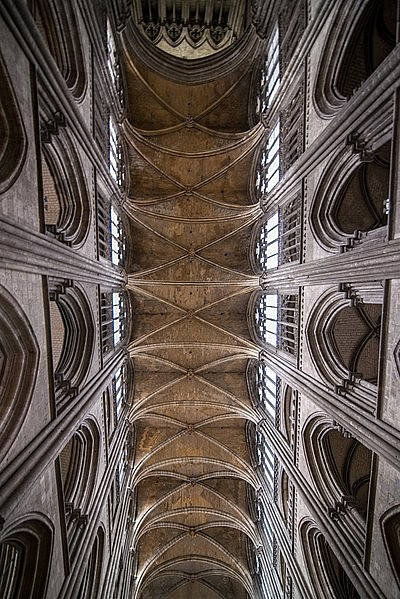
Rib Vaults, Rouen Cathedral
Rose Windows
Visitors to Gothic cathedrals are normally struck past the ethereal purple light streaming in from enormous, circular windows known equally rose windows. Taller buildings allowed for taller windows in full general, but the use of stone tracery to reinforce stained glass windows as well fabricated larger windows possible. Additionally, the use of argent stain in the production of stained drinking glass in the 13th century CE allowed for the creation of a clearer glass, further brightening the interior of Gothic structures. Though examples of round windows can be found in some Romanesque churches prior to the Gothic catamenia, the rose window became a defining characteristic of Gothic cathedrals, and with the development of stone tracery techniques that enabled more panels of glass to be secured into identify, they grew to new proportions. Chartres Cathedral, completed in the early 13th century CE and located southwest of Paris, has peradventure the nearly impressive surviving collection of stained drinking glass dating back to the medieval era.
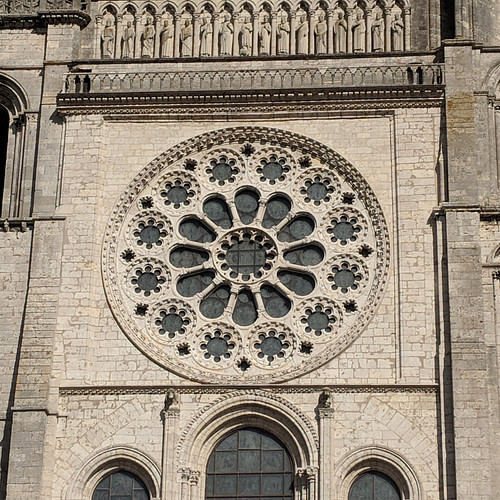
Due west Rose Window at Chartres Cathedral
The Birth of Gothic: Abbot Suger & Saint-Denis
Abbot Suger (1081-1151 CE) was a powerful figure in French republic at an important time in French history when the monarchy'southward power was increasing. Counselor to both Louis Six (1081-1137 CE) and Louis VII (1120-1180 CE), Suger held the position of regent when Louis 7 left for the Second Crusade (1147-1150 CE), which substantially left Suger in charge of France. Appointed abbot of Saint-Denis in 1122 CE, Suger held the position for almost 30 years until his death. Between the years of 1137 and 1148 CE, he embarked upon an ambitious project to transform the church into a physical manifestation of the divine, creating what would become the archetype of the Gothic cathedral. Suger extensively documented his renovations and reasonings in his writings known as The Book of Suger, Abbot of Saint-Denis: On What Was Done Under His Administration.
Suger believed that luminous & beautiful material objects could help spiritually transport the beholder towards the divine realm.
Suger's renovations began with the west façade of the church. The add-on of three portals on a due west-facing façade, besides as the soon-to-be ubiquitous rose window, are substantially innovations of Suger. Largely influenced by Pseudo-Dionysius the Areopagite's metaphysical agreement of light, Suger believed that luminous and beautiful fabric objects could help spiritually transport the beholder towards the divine realm. For Suger, the church occupied a sort of liminal space betwixt the earthly and heavenly realms. The intentional use of lite, therefore, was a driving force behind his renovations, the chief reason for bringing together the defining architectural characteristics of the Gothic manner in a unmarried building for the first time. Suger'southward infatuation with light is exemplified by the words he had inscribed on ane of the cathedral'due south gilded bronze doors:
All you who seek to honour these doors,
Marvel non at the gold and expense but at the
craftsmanship of the work.
The noble piece of work is bright, but, beingness nobly bright, the work
Should brighten the minds, assuasive them to travel through
the lights
To the true calorie-free, where Christ is the true door.
The golden door defines how it is imminent in these things.
The slow listen rises to the truth through material things,
And is resurrected from its one-time submersion when the
light is seen. (Suger & Panofsky, 23)
Suger believed his brighter church would "burnish the minds" of his congregation, leading "to the true light, where Christ is the true door." He also specifically states that textile objects can serve every bit channels for the divine truth: "the dull listen rises to the truth through cloth things." A medieval theological understanding of materiality to which Suger subscribed held that all textile objects had the capacity to exist vessels of the divine. Suger justified his elaborate renovations and decorations of gold and precious gems because he saw them as literal conduits of the divine. The prevailing belief in the Center Ages was that fabric objects, the fancier and more than beautiful the better, could be instruments for connecting with God, and the cardinal ingredient for activating these objects was low-cal. The use of light in Gothic cathedrals, therefore, became an architectural technique in its ain right; it was merely every bit important to the construction of a Gothic cathedral as flying buttresses and ribbed vaulting. Light was seen as literally being of the divine realm, and Suger took nifty care to eliminate any obstruction to the calculated menses of the divine lite throughout Saint-Denis.
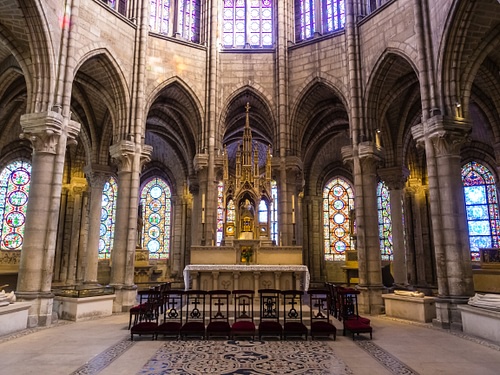
Basilica of Saint-Denis, Master Altar
Light every bit a Guiding Force
In the Heart Ages, there were important epistemological distinctions between the concepts of lux, lumen, and splendor, words used to describe light with varying levels of metaphysical attributes. While lux refers to the natural lite emitted from the sun, lumen is light every bit it interacts with the textile world, and splendor is reflected light. For Suger and those who followed in his footsteps, the signal was not to simply inundation the entire church with equally much calorie-free as possible but to harness lux, lumen, and splendor in specific means. The improver of the rose window at Saint-Denis is a stiff instance of the employ of light to guide the viewer's sight to a college aeroplane, both literally loftier to a higher place, simply also symbolically as a model of the divine realm. The west rose window at Saint-Denis occupies what MIT Professor of Architecture, Dr. Marker Jarzombek, calls a "foreign space in our architectural imagination," not simply a producer of light, but "a floating signifier of Heaven," (Lecture 21 in A Global History of Architecture via edX).
Some other example of guiding light in Gothic cathedrals is at Chartres Cathedral, where the side aisles form a bright outline of the nave, drawing viewers along the widest nave of any cathedral in French republic. The interior brightness of Gothic cathedrals increased from the 12th to 13th centuries CE, from the menses of Early on Gothic to Tardily Gothic (sometimes referred to equally Early Renaissance). Part of this modify tin be attributed to the development of white-colored stained glass. Another interesting phenomenon is the gradual enlargement of the rose window in diverse cathedrals, kickoff with Saint-Denis. A larger rose window is present at Chartres, while the rose window at Westminster Abbey is and then large that information technology touches up against the balustrades that frame it on either side.
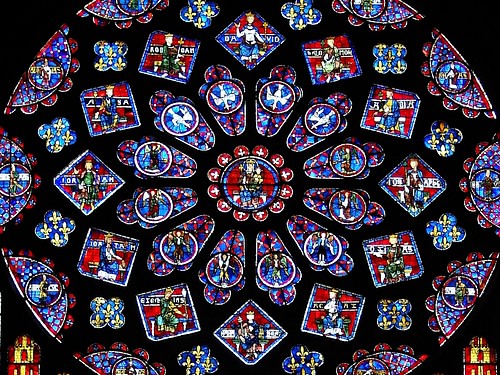
Item, North Rose Window, Chartres
Underlying these shifts are irresolute philosophical beliefs that manifested directly in ecclesiastical compages. As the Middle Ages seceded to the Renaissance, the metaphysical conception of lite gave way to a more scientific understanding. This alter in the conventionalities of the nature of low-cal was a shift from a literal understanding of light as the embodiment of divinity, to a symbolic one where low-cal was a representation of the divine. The way in which low-cal needed to collaborate with the material globe, and the very way in which the materiality of low-cal itself was portrayed and utilized, inverse. As it became more scientifically and less metaphysically understood, perchance light became a metaphor for the divine, equally opposed to the existent thing. Withal, it is impossible to sympathise what the Gothic class meant to the medieval people for whom these structures were built without first agreement their beliefs concerning calorie-free and materiality that informed and inspired these fascinating and beautiful architectural developments.
This commodity has been reviewed for accurateness, reliability and adherence to academic standards prior to publication.
Source: https://www.worldhistory.org/article/1649/gothic-cathedrals-architecture--divine-light/
0 Response to "Main Them Rose Window Is Reinforcing Here With Multiple References to Royalty Ap Art History"
Post a Comment