Museum of the Brooklyn Institute of Arts and Sciences
Brooklyn Institute of Arts and Sciences
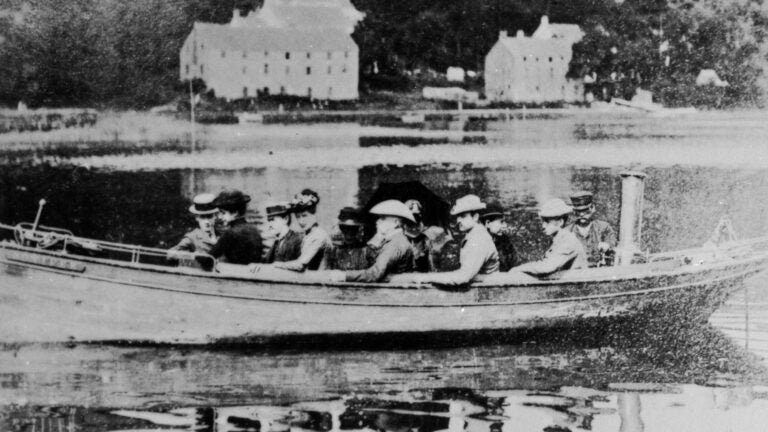 At the finish of the 19th century, the Brooklyn Institute of Arts and Sciences (BIAS) founded a laboratory for training high school and college teachers in marine biology. Every bit biologists and naturalists of that fourth dimension worked out the consequences of Darwin'due south theory of development, they frequently established their laboratories at the seashore, where there was an affluence of animals and plants for written report. In 1889, John D. Jones gave land and buildings (formerly part of the Common cold Spring Whaling Company) on the southwestern shore of Cold Leap Harbor to the Brooklyn Constitute for Arts and Scientific discipline (BIAS). BIAS used the Jones gift to established its presence in Common cold Bound Harbor as the Biological Laboratory (Bio Lab) engaged in science enquiry and grooming of secondary school teachers. In 1917 the Bio Lab officially became one of the four departments of the BIAS (along with the Brooklyn Art Museum, Brooklyn Botanical Garden and Brooklyn Zoo) and an endowment was raised from contributions of interested Cold Leap Harbor neighbors. In 1924 BIAS turned over the administration and buying of the Biological Lab to the Cold Leap Harbor community and information technology incorporated equally the Long Biological Clan (LIBA). LIBA was initially administered by Director Reginald Harris, and connected equally a scientific inquiry and educational institution, funded past local residents and a far reaching list of private donors.
The collection represents cloth generated, accumulated, and maintained by the Brooklyn Found of Arts and Sciences (BIAS) Biological Laboratory founded in 1890 for training loftier school and higher teachers in marine biology in Cold Spring Harbor, New York. The BIAS Biological Laboratory Drove ends in 1924 when the Biological Lab and its functions were transferred to the Long Island Biological Association.
These records have been stored on site since their creation, originally in authoritative offices nether diverse Laboratory Directors until their removal to the Cold Bound Harbor Laboratory Library and Archives. Documents within the collection identify these records every bit those belonging to the Brooklyn Institute of Arts and Sciences—The Biological Laboratory. During most of its existence the organization shared directors, certain staff and buildings, with three related peer institutions: i) Carnegie Plant of Washington 2) Eugenics Record Office (established as a separate entity in 1910, but whose building, files and records were donated to Carnegie Institution of Washington in 1918); and iii) The Long Island Biological Association. This shared leadership created an intermingling of these institutions' administrative files. Where folders were clearly identifiable every bit belonging to another establishment as determined by date, person, or subject, the processing archivists removed the folders for placement in the relevant Related Collections. Where folders independent material which overlapped multiple collections, the folder was kept in this collection and reference notes added. Information technology is recommended that this collection be researched in conjunction with Related Collections. This collection was processed in June 2012.
The Collection is composed of material accrued in the administration of the Bio Lab by manager Dr. Charles B. Davenport with the close guidance and funding by the Bio Lab trustees. These materials have been moved several times through various lab administrations and research projects and were non in original club. These documents include the Bio Lab Trustee series, consisting of one box of minutes of 1898–1922 reflecting fiscal, administrative and curriculum issues. Nine boxes of documents from the administration of the summer and year-round biological study programs 1898–1922 contain the Bio Lab Authoritative series. These two series reflect historically interesting facets of a scientific establishment that survived privatization, Earth War I and financial challenges of a tuition-financed educational institution. The BIAS Trustee series is one box of material documenting the oversight by BIAS, the parent organization. These minutes reflect the arts and science entities within BIAS that were competing for resources and the eventual 1924 launch of the contained successor institution, the Long Isle Biological Association. The fourth series, Bio Lab Business relationship Ledgers consists of four boxes of ledgers with detailed handwritten entries of students' information, finances, and sundry items. These ledgers provide an overall depiction of life during the beginning of the twentieth century in Cold Spring Harbor. Documents constitute in this collection reflect the interaction and interrelationship of this Biological Laboratory with the Village and citizens of Laurel Hollow, the Brooklyn Constitute of Arts and Sciences and the neighboring institution the Carnegie Institute of Washington Station for Experimental Evolution.
The Drove is organized into iv series:
- Serial 1: Biological Laboratory Trustees (1898–1922)
- Series 2: Bio Lab Administrative (1890–1922)
- Series 3: BIAS Trustees (1915–1924)
- Series four: Bio Lab Account Ledgers (1902–1941)
Digitized volumes of the Brooklyn Found of Arts and Sciences Year Books are available via Google Books and Net Archive.
Source: https://www.cshl.edu/archives/institutional-collections/brooklyn-institute-of-arts-and-sciences/
0 Response to "Museum of the Brooklyn Institute of Arts and Sciences"
Post a Comment